Reportajen Adroaldo “Saretukau”
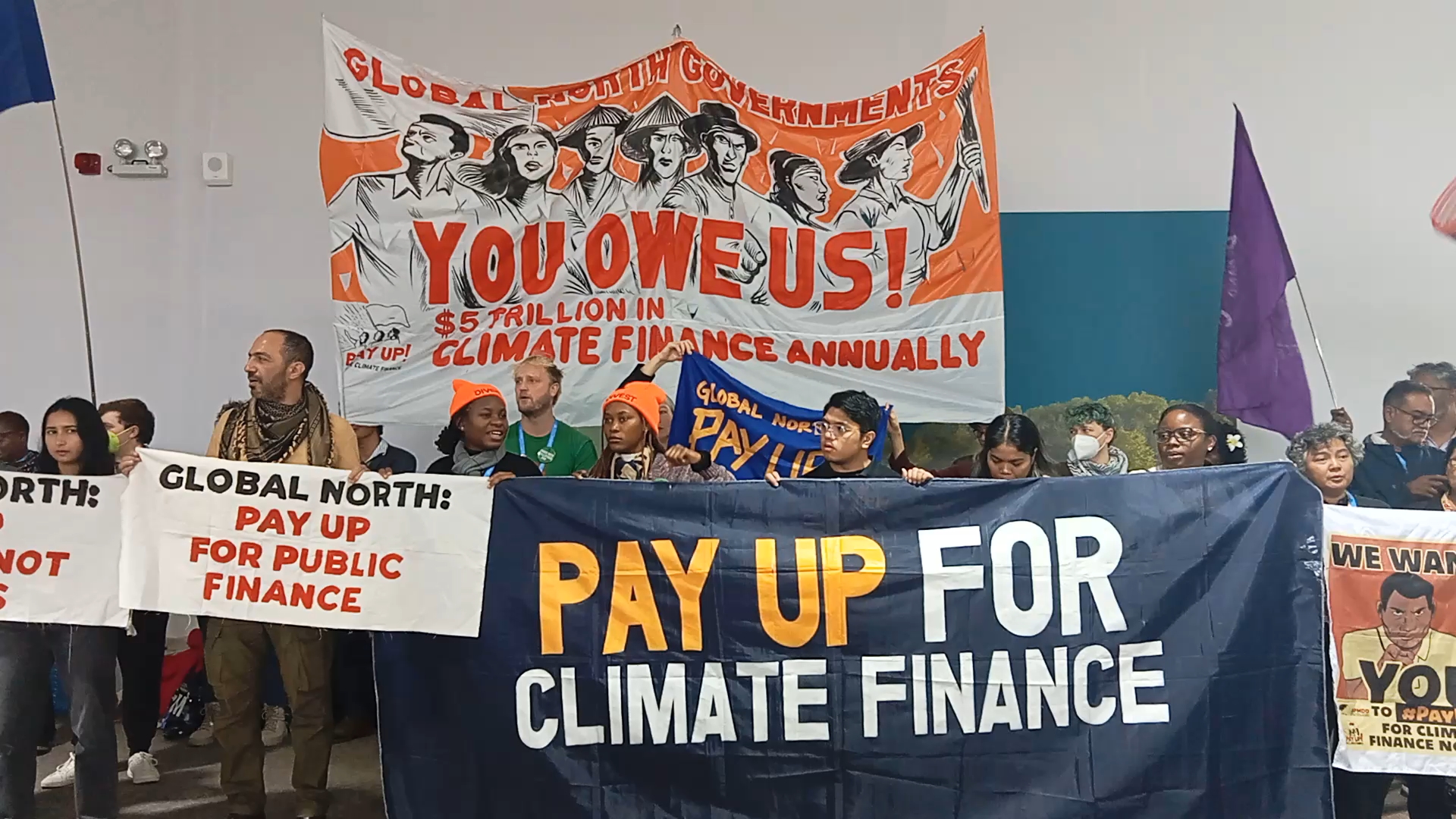
The UN Climate Change Conference (COP29) wrapped up today (November 24) in Baku, Azerbaijan, with a major commitment to ramp up climate finance and help vulnerable countries protect their people and economies from climate disasters. The new finance goal also aims to ensure that all nations can share in the benefits of the growing clean energy sector, however, international civil society protested the deal and considered it as a bad deal.
In his closing remarks, Simon Stiell, Executive Secretary of UN Climate Change, hailed the new finance goal as a crucial “insurance policy for humanity” in the face of worsening climate impacts worldwide. He warned, however, that the goal would only succeed if the promised funds are delivered on time and in full. “Like any insurance policy, it only works if premiums are paid. Promises must be kept to protect billions of lives,” Stiell emphasized.
The new climate finance framework aims to keep the momentum of the clean energy boom alive, benefiting countries worldwide with new jobs, stronger economic growth, and access to cheaper, cleaner energy. “We needed this to be an enabling COP, one that turned the pledges of COP28 into real-world outcomes to protect people, prosperity, and the planet,” Stiell said.
A key outcome of COP29 was the agreement to significantly boost financial support for climate resilience. The deal aims to finance concrete protections for countries and communities on the frontlines of climate change, with a focus on the most vulnerable nations. “COP28 set the goal of boosting climate resilience, and COP29 will help make those protections a reality,” Stiell noted.
In addition, COP29 saw a historic breakthrough on carbon markets, after nearly a decade of difficult negotiations. While not every country got everything it wanted, Stiell acknowledged that the deal was a step forward in addressing global emissions and accelerating the transition to a low-carbon economy.
A major achievement of COP29 was the agreement to triple climate finance to developing countries. The goal is to increase annual climate finance from the previous target of $100 billion to $300 billion by 2035. The summit also set a target to mobilize a total of $1.3 trillion per year by 2035, combining both public and private funding sources, to help developing nations address the impacts of climate change and transition to clean energy.
Stiell concluded by acknowledging the substantial work that still lies ahead. “No country got everything they wanted, and we leave Baku with a mountain of work to do,” he said. “But this agreement represents a critical step toward a more equitable and sustainable future for all.”
With COP29’s focus on climate finance, the hope is that this ambitious new framework will translate into meaningful action for those most affected by climate change, while also driving a global shift toward a greener and more resilient global economy.
However according to the analysis of online media transform.europe (https://transform-network.net) the COP29 deal is a bad deal and providing insightful analysis for their news piece.
transform.network analyse that though developing countries have called for at least $1.3 trillion per year in climate finance for mitigation, adaptation, and addressing loss and damage, this figure is a fraction of what wealthy nations spend annually on fossil fuel subsidies and military expenditures. For instance, the U.S. wars post-9/11 have cost an estimated $8 trillion by 2022, while OECD countries are projected to spend $514.1 billion on fossil fuel subsidies in 2023 alone.
Meanwhile, the 29th UN climate conference (COP29), which wrapped up last weekend, ended with outcomes that can only be seen as a win for international polluters and a loss for the world’s most vulnerable populations. Many are already decrying the ongoing humanitarian crises from brutal wars, with tensions escalating between geopolitical blocs. Some speak of a new Cold War, pitting the traditional “West” against the rising powers of the Global South. But at COP29, a different coalition stood in opposition—the “Alliance of Small Island States.” Cedric Schuster, the chair of the group, expressed the despair of island nations: “Our islands are sinking. How can you expect us to go back to the women, men, and children of our countries with a bad deal?”
The COP29 decisions fail to reflect the urgency of the climate crisis. Time is running out, and delaying the phase-out of fossil fuels is no longer an option. Extreme weather events linked to climate change have already caused at least $41 billion in damages this year alone. The recent floods in Valencia, Spain, could result in another €10 billion in losses. Fossil fuels—coal, oil, and gas—are the primary drivers of climate change, responsible for over 75% of global greenhouse gas emissions and nearly 90% of all carbon dioxide emissions. Many climate scientists now believe that keeping global warming below 1.5°C is already out of reach.